David Stairs
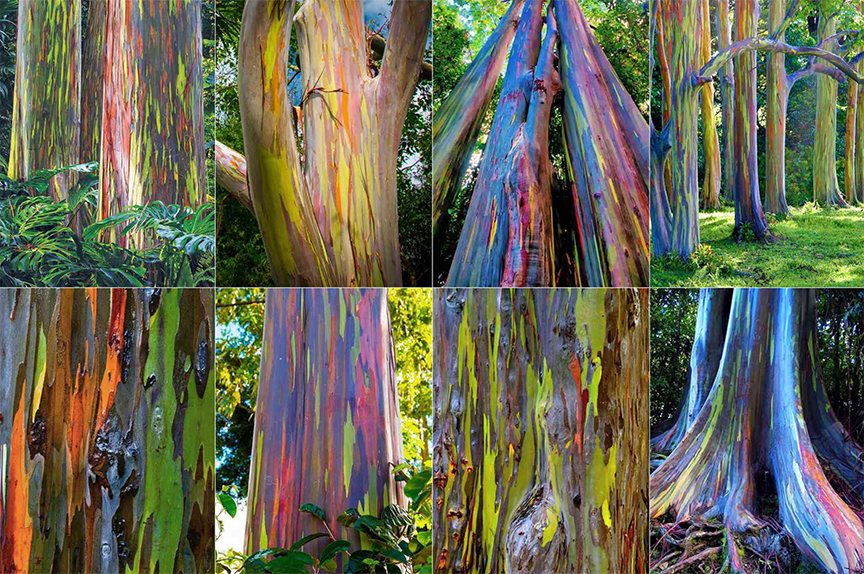
Rainbow eucalyptus trees. Courtesy Vincent Callebaut Architects
Almost thirty years ago I published an essay in Design Issues, subsequently anthologized in The Designed World, about how, in a world evolved for biophilia, the design world leaned toward technophilia. I am happy to say that, although the problem hasn’t been solved, it is finally being addressed.
In a June 2025 piece on the BBC website Deborah Nicholls-Lee documents recent advances in biophilic architectural design, from Stefano Boeri’s now famous Bosco Verticale in Milan to a number of other projects the world over. I’m not naive enough to believe that “vertical forest” highrises are going to replace concretized urban landscapes, but in 1997 tree-enshrouded apartment buildings were pie-in-the-sky.
The concept of biophilia was first proposed by biologist Edward O. Wilson, an eminent entomologist or “ant man” who had studied the industrious six-legged creatures world wide. Wilson suggested that there was an innate, likely genetic predisposition for the natural world born of our evolution out of it, and that the man-made world was hard-pressed to replace this predisposition.
Following Boeri’s 2015 success, high rise forests have been built in cities ranging from Cairo to Eindhoven to Nanjing. At his Secret Gardens housing development in Montpelier French architect Vincent Callebaut hopes that “By transforming residents into urban gardeners and façades into carbon sinks, this building demonstrates that ecology isn’t a constraint but a lifestyle philosophy.” At his recently completed 21-storey-high Tao Zhu Yin Yuan in Taipei, Taiwan, Callebaut has designed a building that has rotating balconies that optimize sunlight. Another project on Cebu, The Rainbow Tree, was inspired by the rainbow eucalyptus tree’s bark.
Biophilia is a recent coinage, but it is not a new concept. Over 2500 years ago, the Babylonians were famous for their hanging gardens. Julia Watson’s Lo-TEK: Design by Radical Indigenism, is a 2019 book that documents examples of biophilic design, such as “living bridges” that have to be nurtured like giant bonsai, by people invested in preserving and living within rather than astride nature. In a world where “development” has become a euphemism for environmental degradation, one can only hope that the current fashion for “resilience” in design sticks around long enough to make a dent in our planned obsolescence society. I shudder to think of what the end of this century will be like if it does not.
David Stairs is the founding editor of the Design-Altruism-Project.