David Stairs
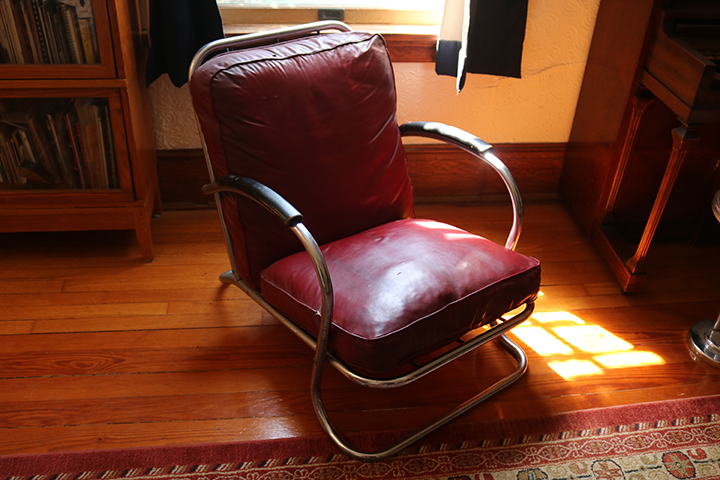
Classic tubular chrome “Barbershop” lounge chair
The design history course I’ve taught for nearly 30 years has been referred to as “the chair class.” That has a lot to do with our species’ need to work and relax in a seated position, and the many designers who’ve chipped in their ideas over the decades. From rush-seat Morris chairs to icons of high concept, like Rietveldt’s de Stijl masterpiece, there are innumerable ways designers have enabled people to defy gravity.
My son has recently become obsessed with designing flat-pack plywood furniture, and has built some sweet pieces. Last year he made a pilgrimage to Donald Judd’s 101 Spring Street to take a closer look at the work of one of his heroes. While Judd’s practice wasn’t centered around furniture design, one can still purchase his custom-order designs from the Judd Foundation.
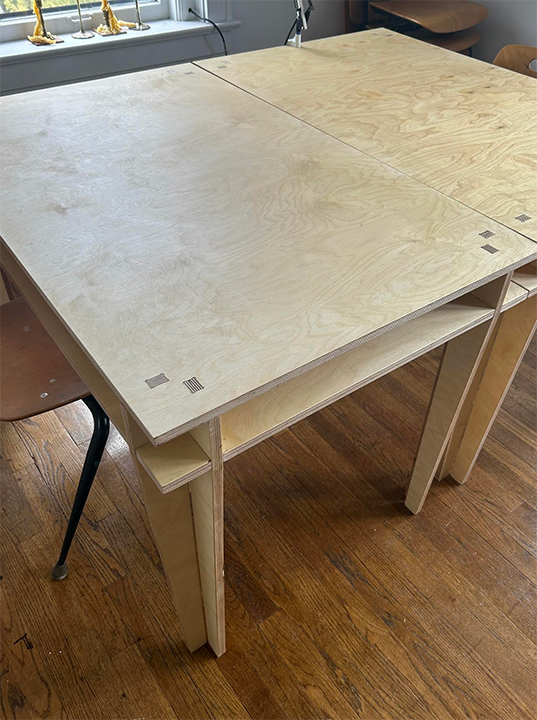
Plywod “shelf” table by Lucien Stairs
Furniture design is often part of an architecture practice. Both Frank Lloyd Wright and Charles Rennie Macintosh designed ladderback chairs at the turn of the 19th century. And Wright conceived of some splendid if famously “tippy” three-legged chairs for the S.C. Johnson company headquarters in Racine. Remembering Mies’ Barcelona chair, or Breuer’s “Wassily chair” got me to wondering what is passing for award-winning seating these days.
Of course, designers love to compete, and there’s no lack of design award shows and competitions each year. A 2025 design winner is Kateryna Sokolova’s Archipen chair. This customizable wooden chair comes in a variety of colors, and is available in both leather and fabric cushion material. A slightly different approach is the Calma chair by Benjamin Hubert. An ergonomic task chair for the workaday world, the Calma also comes in a choice of colors and finishes, with either a wheeled or a static base.
The Piuma chair by Piero Lissoni is a bucket chair similar to the Eames molded fiberglass chairs of the ’50s, while Hiroyoshi Yoneya’s Kyobashi side chair is a bent oak low-back seat that would work at work or at home. Designers continue to experiment with a variety of materials, as they long have. If the 20th century taught us anything it’s that a chair does not necessarily need to be made of wood.
Classic designs by Eames or Nelson continue to be produced by high-end manufacturers like Herman Miller, while Asian factories flood the market with cheap imitations of both. But my brief survey of current designs suggests to me that there is no dearth of original ideas about how we should support our bottoms twenty inches off the floor. With 7+ billion potential customers, chair designers should have plenty of inspiration to work with for years to come.
David Stairs is the founding editor of the Design-Altruism-Project.