David Stairs
Paul Kingsnorth’s Against the Machine is the most coherent attack I’ve yet read on what has been called by some “the algorithm” and by others “the singularity” .
Kingsnorth himself describes the techno-capitalist philosophy dominating Western thought and practice as “the Machine,” an anti-natural Enlightenment based system that has resulted in a materialistic, digitally dominated monstrosity poised to eliminate humanity and replace us with a new self-aware life form. This dystopic vision is supported by the comments of developers of Artificial Intelligence, some of whom, ironically, are calling for an immediate cessation of any further AI research.
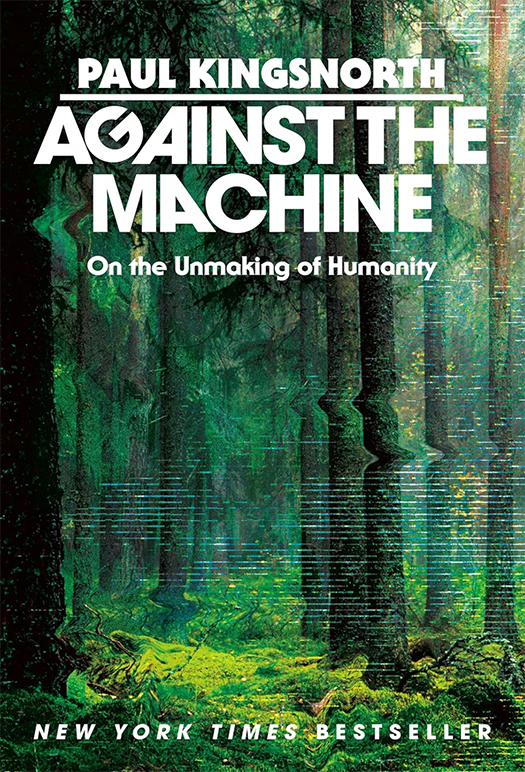
Kingsnorth traces the history of our current condition from its 18th century roots in the self-liberation philosophies of Rousseau and the great revolutions of that era. In a series of metaphorical comparisons, he posits our separation from nature as a result of the distinction between the left linear and right spatial/emotional cerebral hemispheres.
In a chapter titled “The West Must Die” Kingsnorth cites Iain McGilchrist’s The Master and His Emissary in another insightful dichotomy. Where the left brain is designed to help us ap-prehend the world through focused attention, the right brain is best at helping us to com-prehend it through breadth of awareness. In ceding control of our world to the scientific impulse we have created a synecdoche where the “emissary” or left cerebral hemisphere dominates the “Master” or right hemisphere.
Our divestment from our natural “home” combined with our investment in the goals of corporate transnational capital, which originated with enclosure acts that separated people from their land forcing them into urban spaces and factory employment, began our two century journey toward the contemporary electronic universal mind, represented by the Internet.
Among the reasons for the West’s slide into materialistic profanity is its post-Christian loss of a sense of the sacred. Kingsnorth calls for a “reactionary radicalism” that will resist co-option and stand up to “Progress Theology” finding its roots in the four Ps: past, people, place, and prayer.
“This, then, is my idea of an anti-Machine politics. A reactionary radicalism, its face set against Progress Theology, which aims to defend or build a moral economy at the human scale, which rejects the atomised individualism of the liberal era and understands that materialism as a worldview has failed us.”
The rebuilding of this re-humanized world, a world which rejects notions of mechanical transhumanism, will not be easy, so far along the path to destruction have we progressed. It will take the participation of both those currently working inside the Machine, which is a majority of people, who Kingsnorth calls the “cooked,” and those who remain “raw,” the outsiders and resisters who have so far escaped the Machine’s control.
Calling on a huge number of thinkers, from Ellul, Mumford, and Illich to MacLuhan and Simone Weill, Kingsnorth is more inclined to humanist theoriticians than transhumanists like Martine Rothblatt and Ray Kurzweil. The history of humanist social commentary is deeper than that of scientism of course, but the dramatic ascendance of science and technology, buoyed by the phenomenal achievements of a left brain approach to reality, has blinded us to the limits of a partial point of view. For one thing, it overlooks the environmental damage of industrialism, or proposes that more tech will solve the problems it creates.
Kingsnorth’s approach to the world will be poetic anathema to the engineers and code-makers who have created the world of screens we live among. But as a coherent literate review of the crisis of modernity he has made a strong argument for re-enchantment, reevaluation, and the ultimate renewal of life.
David Stairs is the founding editor of the Design-Altruism-Project.